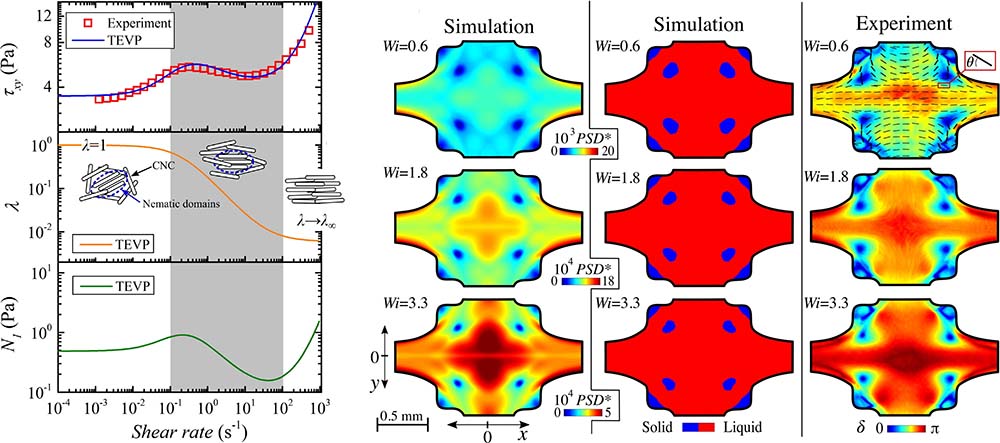
Engineering functional materials requires quantitative relationships between their composition, microstructure, processing history, and macroscopic response. We develop constitutive and multiscale models that capture the complex behavior of fluid-like materials and provide physically grounded descriptions of their rheological and mechanical properties. Whenever possible, we favor first-principles and multiscale models that retain a direct connection between microstructure and macroscopic behavior; however, the complexity of many materials and engineering applications sometimes necessitates phenomenological models calibrated against experimental data. Experiments are therefore integral to our approach, both for validating model predictions and identifying material parameters. By combining modeling and experimentation, we pursue the inverse design of materials with prescribed properties and develop instruments and experimental protocols that enable accurate material characterization.
Related projects: constitutive modeling of suspensions, foams, and emulsions exhibiting complex rheological behavior, including viscoelasticity, plasticity, thixotropy, and aging; multiscale prediction of structure–property relationships; design and optimization of rheometers; and estimation of physical properties from experimental data.